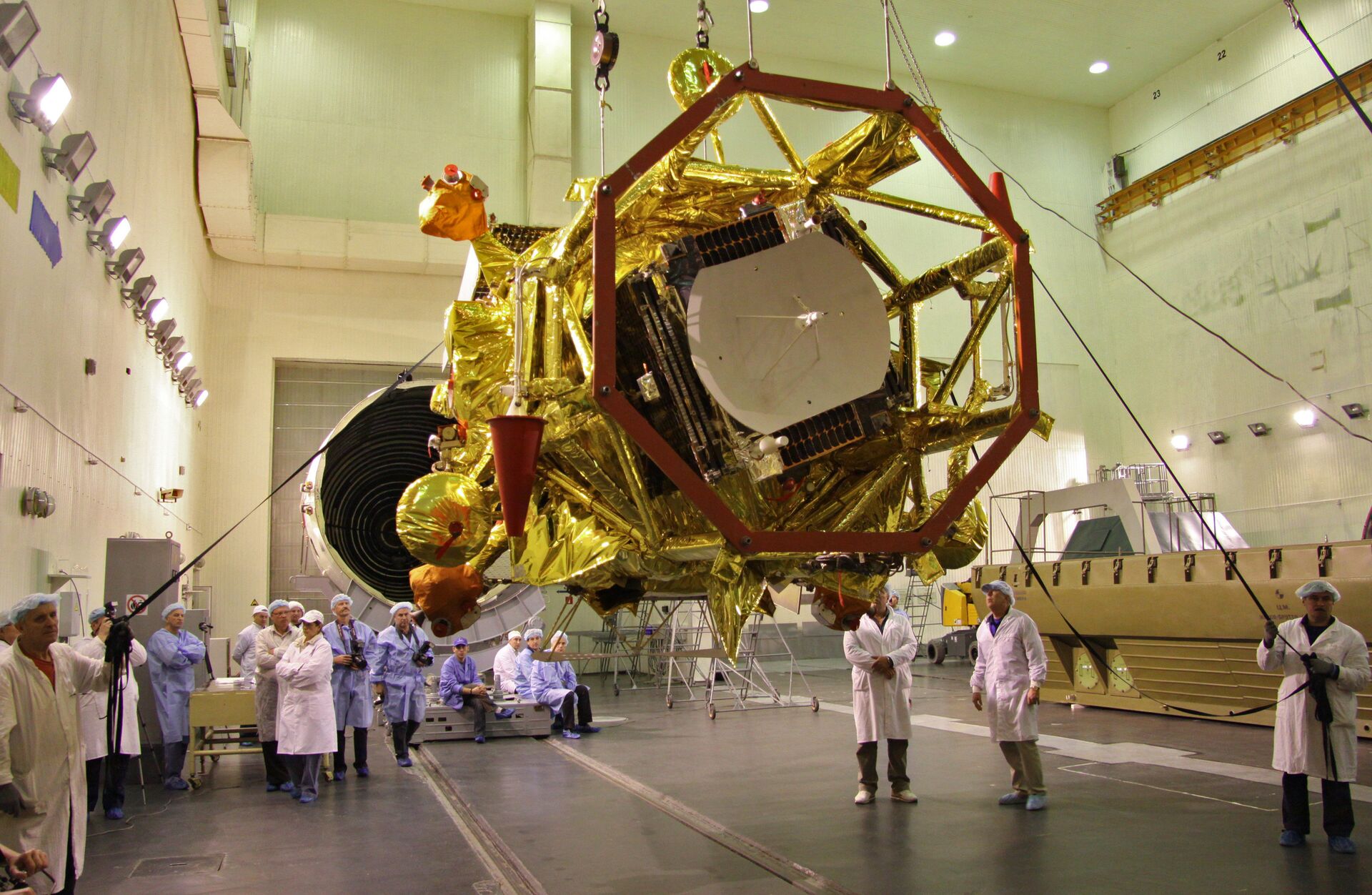
The European tracking station in Perth, Australia, received telemetry from a Russian Mars probe that has been stuck at a low-Earth orbit since after its launch, the European Space Agency (ESA) said on Thursday.
"We have again established contact with the Phobos-Grunt spacecraft, we obtained telemetry reports, they are being analyzed by our colleagues from the Lavochkin Research and Production Association," ESA spokesman Rene Pischel said.
He added that the communication session lasted for only six minutes and though the signal was clear, it is unlikely that all the required information was obtained.
The Mars probe was launched from the Baikonur Space Center in Kazakhstan on November 9. A Zenit carrier rocket put the spacecraft into an initial elliptical based orbit, but the probe failed to fire its engines to put it on course for the Red Planet.
All Russian attempts to establish communications with the spacecraft have been unsuccessful.
The Perth station established first contact with Phobos-Grunt on Tuesday, but it was not ready to receive the data from the spacecraft.
Experts believe that the Mars mission has failed as the last "window of opportunity" for sending the probe on course to Mars closed on Monday, but obtaining telemetric data from the spacecraft could help to find out the causes of the failure and make adjustments for future interplanetary missions.
The deputy head of the Phobos-Grunt project chief scientist, Alexander Zakharov of the Space Research Institute, said the telemetry would show whether the spacecraft could be "reanimated" and used in another research mission.
He said that if the spacecraft is fully operational, the best scientific mission for it would be to study a near-earth asteroid.
"A research of an asteroid is more reminiscent of our initial task than Moon research. The Phobos itself is more like an asteroid and scientific equipment was made for that purpose," he said.
"If we assume that the spacecraft may be reanimated... then we may choose some near-earth asteroid and send the spacecraft there," he said. "However, such mission requires extensive preparations. We would have to calculate the orbit and study energy issues, it would take months."
Meanwhile, the Russian Federal Space Agency Roscosmos has already said it will focus on the Moon as its next step in space research.